Sri Lanka's forest cover is decreasing rapidly

We are Rotarians partnered with like-minded organizations

Thousands of Rotarians, their family members and friends
are helping to plant One Million trees.

Trying to get back what we lost

Our Vision

Healthy living through a greener environment. We hope not only to see more trees being planted, but also that this process will inspire people to keep looking for more ways to make a difference and make their life more sustainable.

Our Mission

To have a greener environment for future generations by inspiring, engaging and supporting people to take personal responsibility for the environment, making it safe, healthy and sustainable and to share the process as a model for the country.

The One Million Tree Story

Helping to regain lost green cover for now and future Generations

INTRODUCTION

Facing a critical decline in Sri Lanka’s forest cover, the One Million Trees project stands as a vital commitment to our island’s future. Launched by Rotary Sri Lanka in partnership with Hayleys PLC, this initiative is more than a planting drive—it is a dedicated promise to regenerate our natural heritage for generations to come. We are turning ambition into measurable action. As of December 2025, the project has
successfully planted 430,000 trees. Every sapling planted brings us closer to our one-million goal, ensuring a healthier, sustainable environment for all Sri Lankans.

THE PROJECT

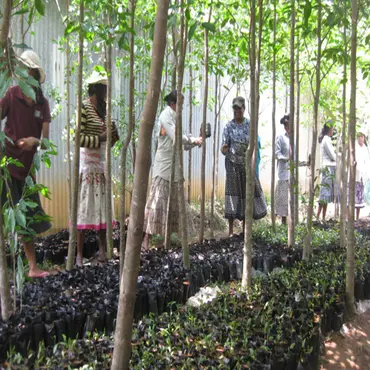
We don’t just plant trees; we ensure they survive. To guarantee lasting ecological restoration, we have modernized our approach with strict scientific protocols and digital transparency.

  • Strategic Locations: Trees are planted in high-conservation value zones, including Hayleys plantations (such as Somerset Estate and Dickoya) and protected reservoirs in Kurunegala.
  • Scientific Selection: We reject a “one size fits all” approach. Instead, we plant sitespecific native and endemic species to ensure ecological harmony and maximum survival.
  • Digital Transparency: Every tree is geo-tagged, allowing sponsors to virtually track the location and growth of their contribution online.
  • The Commitment: Our partner Hayleys PLC nurtures every sapling for a mandatory five years.
  • Your Impact: For just Rs. 100/- per tree, you cover the sapling and its 5-year care. This offers a verified, high-impact way for corporates and individuals to offset their carbon footprint and restore Sri Lanka’s green legacy.
LATEST UPDATE

Resilience and Rapid Growth
The journey of the “One Million Tree Stories” project is a testament to resilience. While the past few years presented unprecedented challenges—from the global pandemic to national economic hurdles—our commitment to reforesting Sri Lanka has never wavered. We faced these headwinds not by slowing down, but by strengthening our alliances, proving that environmental stewardship is a priority that cannot wait.

A New Milestone Reached We are proud to announce that the project has gained massive momentum. As of December 31, 2025, we have successfully planted 430,000 trees across our designated zones. 

Expanding Our Alliances The last 12 months have brought rich rewards in the form of powerful new partnerships. We have seen major corporate stewards step forward to take ownership of Sri Lanka’s future.

  • January 2026: Global Marine Investments enhanced their partnership, committing to 3,000 trees to offset their carbon footprint.
  • Strategic Growth: They join a prestigious coalition of partners including Sampath Bank, Sunshine Holdings, and Crystal Martin, who are helping us expand our planting footprint into critical high-conservation areas like the Somerset Estate in Talawakelle.

With the rains returning and our nursery capacity expanding, we are firmly back on track. The “One Million Trees” vision is no longer just a target; it is a rapidly growing reality, rooted in the soil of our island.
Our forest cover is decreasing

Depletion of natural forest cover during five successive surveys

While the official “Natural Forest” percentage shows a slight stabilization (rising to ~29.2% in 2020 due to conservation efforts and definition updates), independent environmental groups (like CENS) argue that dense forest cover may be significantly lower (around 16%) due to fragmentation. The World Bank reports a higher figure (34% in 2023) because it includes rubber and commercial timber plantations.

While the official “Natural Forest” percentage shows a slight stabilization (rising to ~29.2% in 2020 due to conservation efforts and definition updates), independent environmental groups (like CENS) argue that dense forest cover may be significantly lower (around 16%) due to fragmentation

The percentage of forest land area in green ( source: FAO )

Year Forest Cover (%) Source
1992
31.7%
FAO / FD
1996
29.6%
FAO / FD
2010
28.8%
28.8%
2020
29.2%
Dept. of Forest Conservation (Census)
2010
0%

Our Partners

Initiator & Lead Organizer
Youth Mobilization Partner
School-Level Activism Partner
Strategic & Technical Partner
Banking Partner